
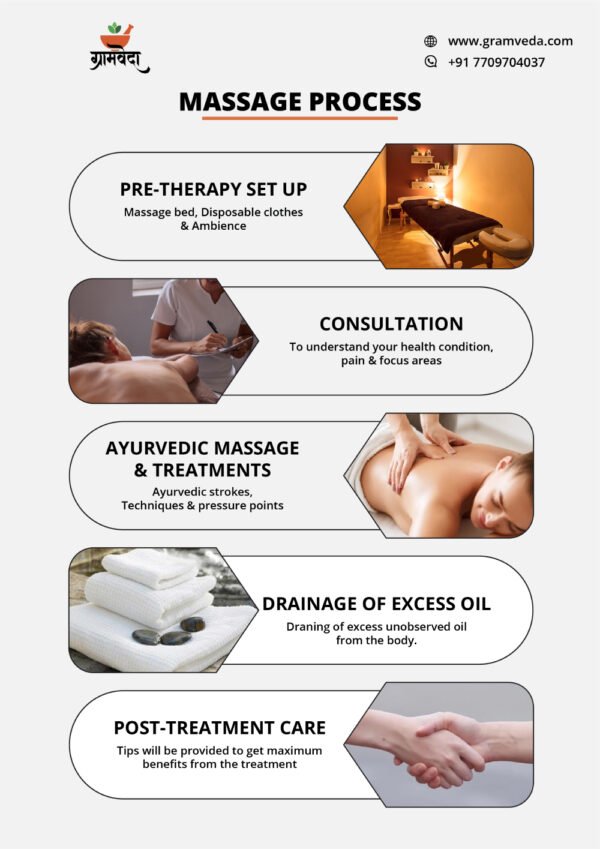
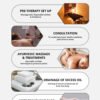

- Pre-Therapy set up – Setting up of a relax ambience & massage bed with single use disposables(Undergarments, Bedsheets & Slippers).
- Consultation – I’ll understand your health condition, pain areas, your personal requirements & preferences to get you the best treatment.
- Ayurvedic massage & treatments – Ancient techniques & ayurvedic medicated herbal oils used.
- Drainage – Draining of excess oil from the body
- Post-treatment care – Tips to get maximum benefits from the treatment & consultation for your next therapy to help you choose better.
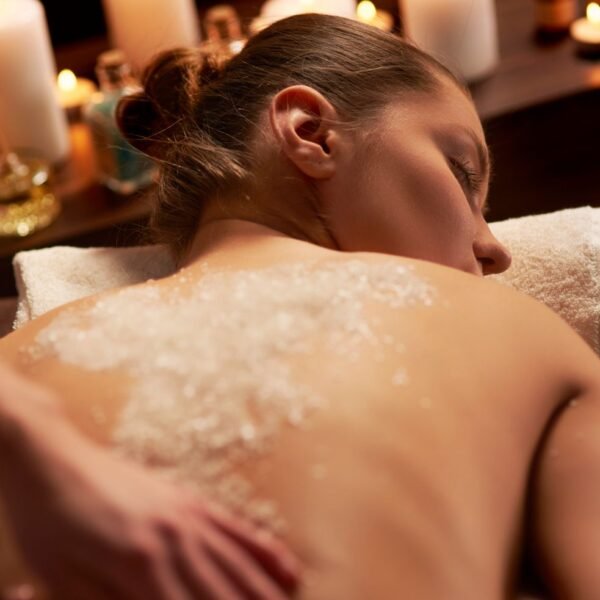
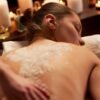
♦ Body scrub will be used made with rice & milk.
♦ Wood pressed pure Coconut oil will be used for body massage.
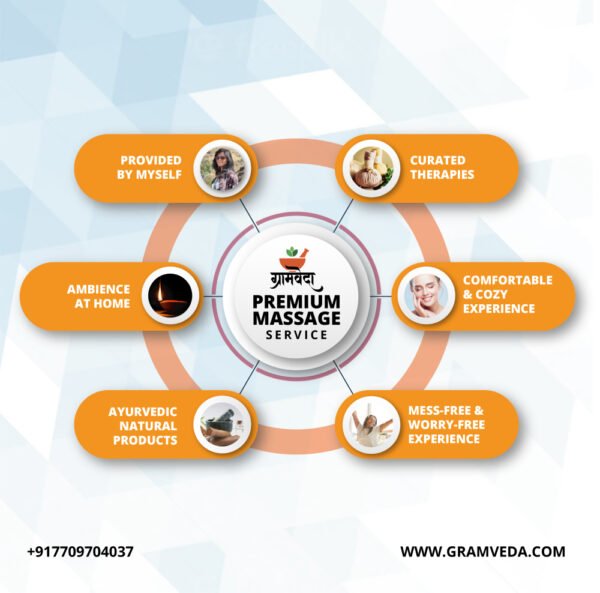
- Ambience – Perfect ambience at home to feel stress free & relax (I’ll bring bed, disposables clothes (Undergarments, bedsheets & slippers) for comfortable, worry free & best experience you ever had)
- Therapist – I’ll do the therapies by my own with ancient Indian techniques.
- Ayurvedic products – All products & oils are ayurvedic medicated herbal products
- Curated therapies – I’ll understand your health condition , pain areas & your personal preferences to get you the best customize therapy as per your needs
- Mess-free experience – Comprehensive post therapy cleanup so you won’t have to worry about the cleaning
♦ Note – Head, face & private body parts are not included in it.
1. First 20 minutes quick full massage will be given,
2. After that, full body scrub will be done,
3. Then you can take a warm water shower (no soap or shower gel).
- Treats winter skin conditions,
- Removes dead skin,
- Removes tanning,
- Gives a smooth, soft & glowing skin,
- Moisturizes the skin,
- Prevent acne,
- Strengthens muscle and many more.
♦ Avoid using any cosmetics products for few hours, if necessary you can use suns cream
♦ Avoid direct sun exposure / Heat / Cold.
♦ Drink plenty of water to remove toxins through urine.
♦ Have a light food for the day to keep digestive system relaxed.
♦ Avoid gym/exercise for the day or do light exercise.
♦ Take lots of rest & a good sleep.
What is ayurveda?
Ayurveda is a Sanskrit word derived from Ayur means Life & Veda means Knowledge or Science. So Ayurveda means “Knowledge of life” or “Science of life”. Ayurveda is an ancient healing practice which is 5000 years old. Maharishi Charaka is known as the father of ayurveda. It’s a unique tradition of India. It’s an ancient & holistic science of wellbeing & longevity (long life). Ayurvedic treatments promote physical & emotional wellbeing.
The Sanskrit word sneha can be translated as both “oil” and “love”. It is believed that the effects of abhyanga are similar to those received when one is saturated with love. Like the experience of being loved, abhyanga can give a deep feeling of stability and warmth. Sneha is subtle: this allows the oil/love to pass through minute channels in the body and penetrate deep layers of tissue.
In Ayurveda, it is believed that there are seven layers of tissue in the body (called dhatus) Paeh successive layer is more concentrated and life-giving. For sneha to reach the deepest layer, it is believed that it must be massaged into the body for 800 matras, roughly five minutes. To give this kind of attention to your entire body, you may need about fifteen-minutes Considering the benefits that have been gained by people for thousands of years, fifteen-minutes per day is a minimal amount of time.
There are four types of Vedas – Rigveda, Samaveda, Yajurveda, and Atharvaveda. The origin of Ayurveda is attributed to Atharva Veda where mention is made several diseases with their treatments.
Those who practice Ayurveda believes that every person is made of 5 basic elements(Pancha mahabhute) found in the universe which are : Air, Fire, Water, Space & Earth. These combine in human body forms three life forces/energies called Doshas : Vata, Pitta & Kapha. These doshas are believed to be responsible for a person’s physiological, mental, and emotional health. Doshas control how our bodies work. Imbalance of any doshas can create an illness/health issues in our body. Everyone inherits an unique mix of these three doshas but one is usually stronger than others. Each dosh is a combination of different elements & control different body functions as below :
| Dosha | Elements | Functions |
| Vata | Air & Space | Movement and Communication |
| Pitta | Fire & Water | Digestion and Transformation |
| Kapha | Water & Earth | Cohesiveness, Structure, and Lubrication |
| Dosha | Qualities |
| Vata | Dry, Light, Cold, Rough, Subtle, Mobile, Clear |
| Pitta | Hot, Sharp, Light, Liquid, Spreading, Oily |
| Kapha | Heavy, Slow, Cool, Oily, Smooth, Dense, Soft, Stable, Gross, Cloudy (Sticky) |
Imbalanced Vata
When out of balance, vata tends to cause fear, anxiety, isolation, loneliness, and exhaustion. It can lead to both physical and energetic depletion, disrupt proper communication, and cause all sorts of abnormal movements in the body, such as tics, tremors, and muscle spasms.
Imbalanced Pitta
When out of balance, pitta causes fiery, reactionary emotions such as frustration, anger, jealously, and criticism. Imbalanced pitta is often at the root of inflammatory disorders, which can affect organs and tissues throughout the body.
Imbalanced Kapha
When out of balance, kapha triggers emotions of attachment, greed, and possessiveness and can also create stubbornness, lethargy, and resistance to change. Physically, kapha tends to invite stagnation and congestion in organs and tissues throughout the body—including the mind.
Common Factors Causing Imbalance in the Doshas
| Vata | Pitta | Kapha |
|---|---|---|
| Staying awake at night or insufficient sleep | Over-exertion | Sleeping during the day |
| Fear, grief, worry, stress | Excessive talking | Excessive sleep |
| Travel | Hot, spicy, salty and sour food | Lack of exercise |
| Excessive exercise, sex or mental activity | Anger, hatred, jealousy, passion | Lack of mental activity |
| Suppression of natural urges | Fasting | Over-eating |
| Irregular daily routine | Alcohol, tobacco, caffeine | Heavy, oily, cold, sweet, sour and salty food |
| Injuries, surgery, childbirth, old age, late fall & winter | Summertime, exposure to heat or mid-day sun, middle age | Childhood, springtime, cool and damp climates |
| Excess pungent, bitter and astringent taste; light dry, rough, raw diet; insufficient food; caffeine | Over-work, over-use of eyes especially with computer screens |
What to do to balance doshas ?
| Vata | Pitta | Kapha |
|---|---|---|
| Go to bed before 10 PM | Cultivate Moderation in all things & Go to bed before 10 PM. | Get up early atleast 6am & |
| Regular daily routine | After brushing the teeth at morning, drink some pure water left overnight in a cup of pure copper | Seek out challenge for your intellect |
| Walk in nature, Yoga, pranayama, meditation | Walk by water, swim, cycling, Yoga & Meditation | Regular & Vigorous exercise |
| Main meal at noon | Main meal at noon | Main meal at noon, Minimize heavy foods, |
| Abhyanga with Pure Sesame oil. Nasya with pure sesame oil |
Abhyanga with pure coconut oil on the head and pure sesame oil on the body. Nasya with pure ghee or pure sesame oil. | Abhyanga with pure plain sesame oil or almond oil. Nasya with pure sesame oil |
| Avoid mid-day sun. Rest the eyes in evening | Liquid fast once a week, Have a light dinner, preferably before 7 PM |
Doshas pacifying diet
Vata-pacifying diet –
♦ Favor warm beverages
♦ Food should be warm, freshly prepared and unctuous
♦ Use liberal amounts of sesame oil. Ghee, butter, olive oil and coconut oil are also good.
♦ Avoid alcohol, caffeinated beverages, and chocolate
♦ Avoid raw or gas-forming vegetables (broccoli, cauliflower, cabbage, kale, etc.)
Pitta-pacifying diet –
♦ Take time to eat a hearty lunch
♦ Favor cool, but not ice-cold, beverages
♦ Food should be freshly prepared and moderately unctuous
♦ Favor ghee in the cooking along with cooling spices like fennel, coriander, cardamom and turmeric. Coconut oil and olive oil are also good.
♦ Avoid chili peppers, vinegar, salt, alcohol, tobacco, caffeinated beverages and chocolate
♦ Before bed, have some milk previously boiled with a little ghee, saffron, cardamom and sugar, once cooled to a comfortable temperature
Kapha-pacifying diet –
♦ Minimize heavy foods
♦ Take 1 tsp. raw honey in a half cup of warm water to start your day
♦ Favor warm beverages
♦ Food should be warm, freshly prepared and not too unctuous
♦ Enjoy spices, especially fresh ginger
♦ Avoid alcohol, caffeinated beverages, chocolate and other sweets
♦ Don’t eat breakfast if you aren’t really hungry
♦ Have a light dinner, preferably before 7 PM
♦ Start a habit of taking a liquid fast one day a week
Reviews
There are no reviews yet.